OpenAM Analysis
Chapter 7: OpenAM Analysis
OpenAM is the central access management component of the Open Identity Platform suite, providing single sign-on, multi-factor authentication, OAuth 2.0/OpenID Connect token issuance, SAML 2.0 federation, and XACML 3.0 policy evaluation within a single deployable WAR artifact. Descended from Sun Microsystems’ OpenSSO via ForgeRock’s stewardship (see Chapter 1), it carries one of the deepest feature sets of any open-source IAM system — 34+ pluggable authentication modules, a complete OAuth 2.0 authorization server, and an entitlement engine capable of fine-grained attribute-based access control. That breadth is both its greatest asset and its heaviest burden: the codebase spans roughly 51 Maven modules, carries legacy UI code from the Sun era, and demands significant operational expertise to deploy and maintain. This chapter examines OpenAM’s architecture in detail, evaluates its strengths and weaknesses, and positions it against modern alternatives ranging from Keycloak to the Ory stack to commercial SaaS platforms.
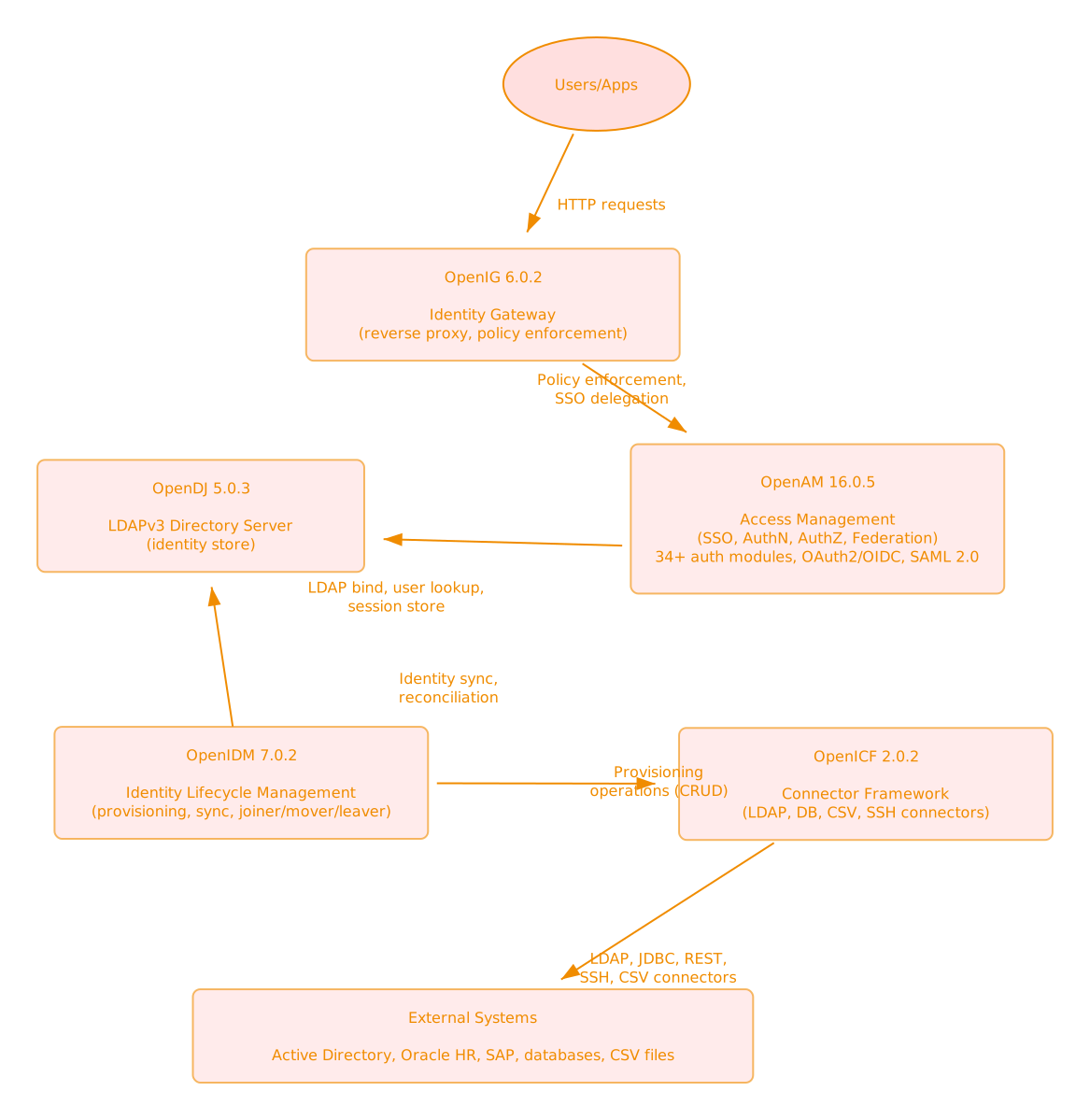
1. What OpenAM Does
OpenAM serves as a centralized authentication and authorization hub for web and API applications. Its core capabilities include:
- Single sign-on (SSO) across web applications using cookie-based session management, with cross-domain SSO via the Core Token Service (CTS).
- Authentication through 34+ pluggable modules organized into configurable chains, supporting LDAP, Kerberos, OAuth 2.0, OIDC, SAML 2.0, WebAuthn/FIDO2, HOTP/TOTP, push notifications, device fingerprinting, and scripted custom logic.
- Authorization via an XACML 3.0-compliant policy engine implementing PEP/PDP architecture with resource pattern matching, subject/environment conditions, and deny-overrides combining.
- Federation as both SAML 2.0 Identity Provider and Service Provider, with WS-Federation support and identity brokering for social login.
- OAuth 2.0 / OpenID Connect authorization server with support for authorization code, client credentials, password, JWT bearer, and device code grant types, plus token introspection, revocation, and dynamic client registration.
These capabilities make OpenAM suitable for enterprises requiring a self-hosted identity hub that can federate with partners, protect APIs, and authenticate users through multiple factors — all without vendor lock-in to a commercial SaaS platform.
2. Architecture Overview
Authentication Chain Model
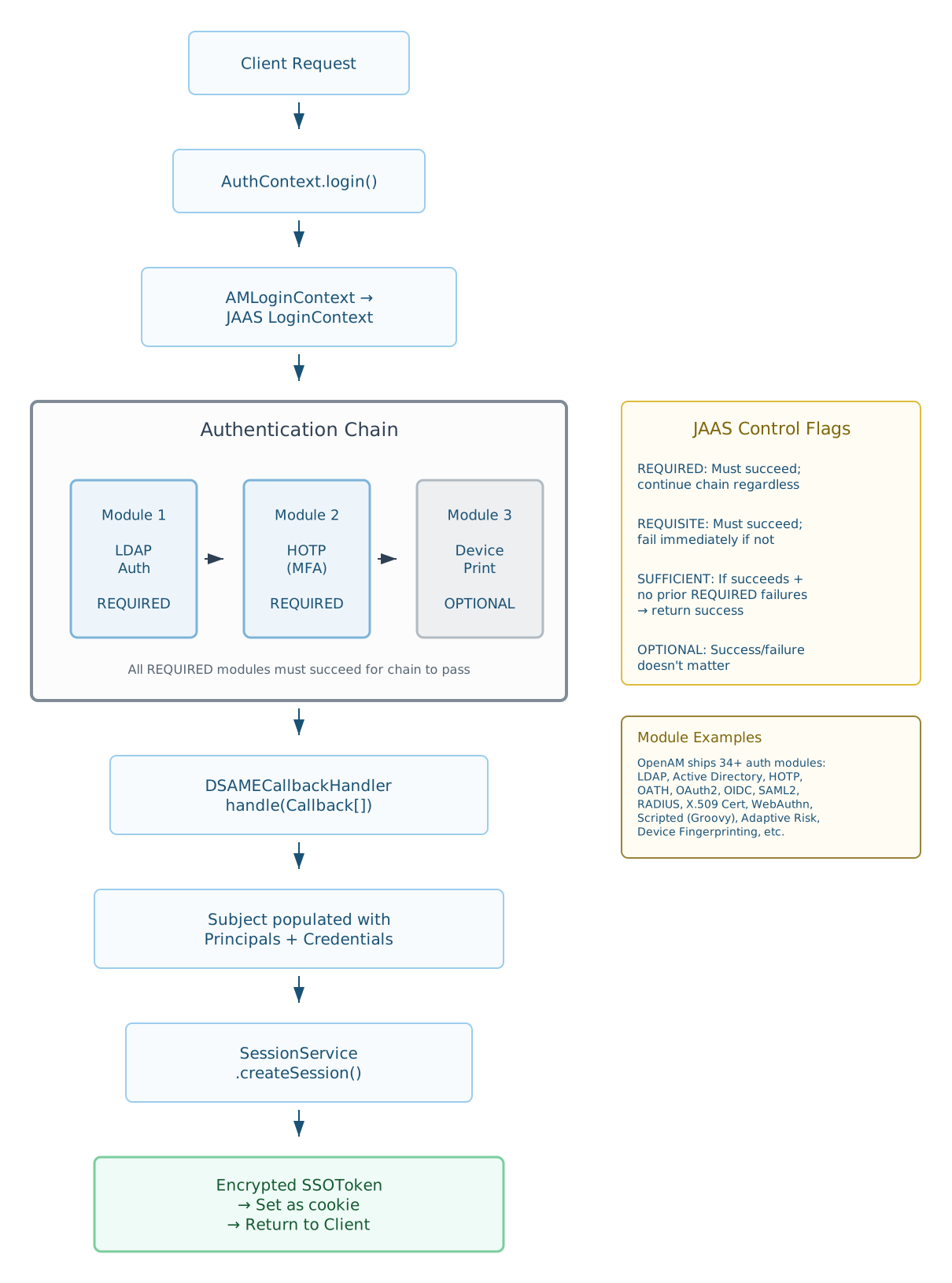
OpenAM’s authentication system is built on the Java Authentication and Authorization Service (JAAS) framework, implemented as a Chain of Responsibility pattern where multiple authentication modules execute in sequence according to configurable control flags.
The core classes that implement this model reside in OpenAM/openam-core/src/main/java/com/sun/identity/authentication/:
AuthContext.java— The public client-facing API. Applications callAuthContext.login()to initiate authentication and handle callbacks (username prompts, password prompts, OTP challenges) in a conversational loop.AMLoginContext.java— The orchestration layer. It instantiates the JAASLoginContext, wires up the configured chain ofAMLoginModuleinstances, and manages pre/post-authentication processing hooks.AMAuthenticationManager.java— The service locator. It loads authentication chain configurations and module instances from the LDAP-backed service schema, resolving module class names to concrete implementations at runtime.AMLoginModule.java(in thespi/package) — The base class all authentication modules extend. It implements the JAASLoginModulecontract (init(),login(),commit(),abort(),logout()) and communicates with clients viaCallbackobjects.LoginState.java— Maintains stateful context across multi-step authentication flows, tracking the current module, failed attempts, and callback history.
Each module in a chain carries a JAAS control flag — REQUIRED, REQUISITE, SUFFICIENT, or OPTIONAL — that determines how its success or failure affects the overall chain outcome. This design enables composable multi-factor flows: a chain might require LDAP password verification (REQUIRED), then offer TOTP as a second factor (REQUIRED), with a persistent cookie check as a bypass (SUFFICIENT).
The data flow proceeds as:
Client -> AuthContext.login() -> AMLoginContext -> JAAS LoginContext.login() -> Chain of AMLoginModule instances -> DSAMECallbackHandler.handle(Callback[]) -> Module validates credentials -> Subject population -> Final Subject with Principals + credentials -> SessionService.createSession()New authentication modules are added by extending AMLoginModule and providing an XML service schema definition. Each module lives in its own Maven submodule under OpenAM/openam-authentication/ — for example, openam-auth-ldap/ contains LDAP.java (the module implementation) and amAuthLDAP.xml (the service schema). This structure enables selective inclusion at build time.
Session Management
Session management is handled by the SessionService class at OpenAM/openam-core/src/main/java/com/iplanet/dpro/session/service/SessionService.java. After successful authentication, the service creates an InternalSession object containing the session ID, creation timestamp, expiration, idle timeout, and arbitrary string properties. The session ID is encrypted into an SSOToken that travels to the client as a cookie or header value.
Session storage is pluggable through backend adapters:
| Backend | Module | Use Case |
|---|---|---|
| CTS/LDAP (default) | openam-core/ | Single-node or small cluster, backed by OpenDJ |
| Cassandra | openam-cassandra/ | Horizontally scalable, multi-datacenter HA |
| Redis | OIP extensions | High-throughput caching layer |
| Custom | SessionStore interface | Organization-specific backends |
The Cassandra backend (OpenAM/openam-cassandra/) was added by the OIP community to address the CE-era limitation of single-node session stores. It supports multi-master replication across data centers with TTL-based token expiration, enabling the kind of horizontal scaling that production deployments require.
Session lifecycle follows a well-defined sequence: creation after authentication success, token issuance with encrypted session ID, storage in the chosen backend, replication across cluster nodes, TTL-based or idle-timeout expiration, blacklist entry on logout, and final destruction. Session constraints (enforced by SessionConstraint.java) limit concurrent sessions per user, preventing session abuse.
Policy Engine (XACML 3.0)
Authorization decisions are made by the entitlement engine in OpenAM/openam-entitlements/. The engine implements a PEP/PDP architecture where Policy Enforcement Points request decisions from the Policy Decision Point:
Client Request -> PolicyEvaluator.evaluate(resource, action, subject, environment) -> Load applicable policies from PolicyStore -> Evaluate conditions (subject, resource, action, environment) -> Short-circuit on DENY (deny-overrides combining) -> Aggregate permits -> Return decision + obligations -> Cache result (TTL-based invalidation)Policies are structured as combinations of resource patterns (URI wildcards, regex), subjects (users, groups), actions (HTTP methods), environment conditions (IP range, time window, device type), and effects (Allow/Deny). Policies are stored in the OpenDJ LDAP backend as LDIF entries, making them subject to the same replication and backup mechanisms as identity data.
Extension points include custom subject matchers (extending SubjectImplementation), custom resource comparators (extending ResourceMatch), and custom environment evaluators (extending EnvironmentImplementation).
OAuth 2.0 / OIDC Provider
The OAuth 2.0 implementation resides in OpenAM/openam-oauth2/src/main/java/org/forgerock/oauth2/core/ with approximately 80 classes. Key interfaces follow the Strategy pattern for extensibility:
| Class | Role |
|---|---|
AuthorizationService | Handles /authorize endpoint |
AccessTokenService | Handles /token endpoint |
ResponseTypeHandler | SPI for code, token, id_token response types |
GrantTypeHandler | SPI for authorization_code, client_credentials, password, jwt-bearer, device_code |
TokenStore | SPI for pluggable token persistence (CTS-backed default) |
ScopeValidator | SPI for custom scope validation logic |
The authorization code flow proceeds through request validation, resource owner authentication (delegating to the authentication chain), consent verification, authorization code generation and storage, and finally token exchange. OIDC extensions add ID Token (JWT) issuance alongside access tokens, a UserInfo endpoint for profile claims, and a discovery endpoint at /.well-known/openid-configuration.
Plugin SPI
OpenAM’s extensibility is built on a Service Locator + Factory pattern. Authentication modules are discovered via classpath scanning for AMLoginModule implementations, with XML/LDAP service definitions loaded at startup. Module properties are mapped from LDAP distinguished names to object attributes, and constructor instantiation occurs with configuration parameters injected from the service schema.
Post-authentication processing is handled through the AMPostAuthProcessInterface, which enables custom logic to execute after successful authentication — session attribute injection, audit logging, external system notification, or conditional step-up requirements.
Authentication Module Inventory
The complete module inventory spans seven categories, each living in its own Maven submodule under OpenAM/openam-authentication/:
| Category | Modules | Description |
|---|---|---|
| Directory/LDAP | openam-auth-ldap, openam-auth-ad, openam-auth-nt, openam-auth-ntlmv2, openam-auth-membership | Standard directory authentication including Active Directory, LDAP bind, NTLM, and membership validation |
| Multi-factor | openam-auth-hotp, openam-auth-oath, openam-auth-fr-oath, openam-auth-push, openam-auth-webauthn | HOTP, TOTP (OATH), ForgeRock OATH variant, mobile push approval, FIDO2/WebAuthn passkeys |
| Federation/Social | openam-auth-oauth2, openam-auth-oidc, openam-auth-saml2 | OAuth 2.0 social login, OpenID Connect authentication, SAML 2.0 as an authentication module |
| External | openam-auth-radius, openam-auth-msisdn, openam-auth-securid, openam-auth-cert, openam-auth-recaptcha | RADIUS server, mobile subscriber MSISDN, RSA SecurID, X.509 client certificates, Google reCAPTCHA |
| Persistence | openam-auth-persistentcookie, openam-auth-windowsdesktopsso | Persistent cookie-based re-authentication, Windows Desktop SSO via Kerberos |
| Scripting | openam-auth-scripted, openam-auth-amster | Groovy-scripted custom auth logic, Amster-based admin provisioning auth |
| Advanced | openam-auth-device-id, openam-auth-qr, openam-auth-application, openam-auth-adaptive, openam-auth-anonymous, openam-auth-httpbasic, openam-auth-jdbc | Device fingerprinting, QR code, application tokens, risk-adaptive scoring, anonymous access, HTTP Basic, JDBC database auth |
The evolution across forks is significant. ForgeRock CE 11.0.3 shipped 20 modules. OIP 16.0.5 added 11 (OIDC, SAML2, WebAuthn, QR, push, device-id, scripted, recaptcha, ntlmv2, fr-oath, amster). Wren:AM 16.0.0-M1 adopted a selective subset: it kept 27 modules, dropped 4 (WebAuthn, QR, recaptcha, ntlmv2), and added its own Duo Security MFA integration (wrenam-auth-duo). The Wren strategy favors quality over breadth — fewer modules to maintain, with Duo covering enterprise MFA requirements that the dropped modules partially served.
Fork Divergence in Dependencies
The three forks diverge significantly in their technology stacks, as detailed in History and the version-evolution extract. The most architecturally consequential divergence is Guice dependency injection:
- ForgeRock CE 11.0.3: Guice 3.0
- OIP 16.0.5: Guice 7.0.0 (modern DI, breaking changes vs 3.0)
- Wren:AM 16.0.0-M1: Guice 3.0, wrapped in
wrensec-guice-coreandwrensec-guice-servlet
OIP’s upgrade to Guice 7.0.0 modernizes the DI container but breaks backward compatibility with extensions compiled against Guice 3.0. Wren deliberately retained Guice 3.0 to preserve enterprise extension compatibility, wrapping it in namespace-isolated artifacts. This divergence means that custom authentication modules, post-authentication processors, and policy plugins are not binary-compatible between OIP and Wren builds — a consideration for organizations maintaining custom extensions.
Other notable dependency differences include Jackson (OIP conservative at 2.3.x, Wren modern at 2.15.2), SLF4J (OIP on 1.7.x, Wren on 2.0.17), Restlet (OIP 2.4.4, Wren 2.6.0), and Jakarta EE level (OIP partial jakarta.servlet 4.0+, Wren full jakarta.servlet 5.0.0). Wren’s aggressive dependency modernization, combined with its conservative Guice strategy, reflects a deliberate architectural choice: update everything except the plugin contract surface.
Production Deployment Topology
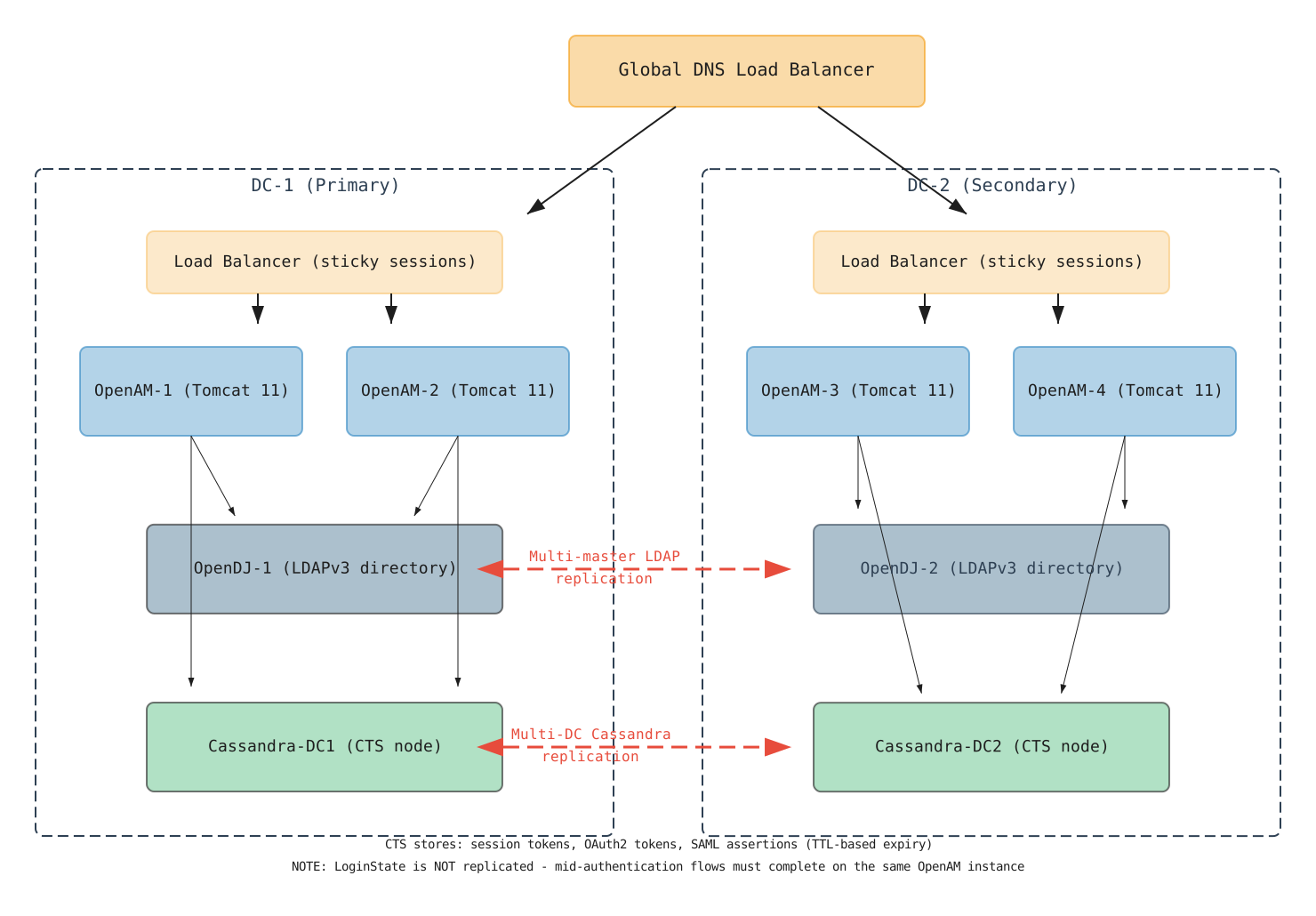
A production OpenAM deployment follows a well-established topology pattern that has evolved since the ForgeRock era. The reference architecture consists of three tiers: a load balancer layer, an application layer running multiple OpenAM instances, and a data layer backed by replicated OpenDJ.
High-availability deployment. The minimum HA configuration runs two or more OpenAM instances (Tomcat/Jetty) behind a load balancer configured for sticky sessions (cookie-based affinity using the amlbcookie). Each OpenAM instance points to a shared OpenDJ topology — typically two OpenDJ instances in multi-master replication — for configuration, identity, and CTS data. The load balancer must be configured to route the initial authentication request and all subsequent callback exchanges to the same OpenAM node, since authentication state (LoginState) is held in-memory during the JAAS chain execution. After authentication completes and a session is created, the session is persisted to CTS, and subsequent requests can be routed to any node.
┌─── OpenAM-1 (Tomcat) ───┐Internet → LB (sticky) ─┤ ├─→ OpenDJ-1 ⟷ OpenDJ-2 └─── OpenAM-2 (Tomcat) ───┘ (multi-master replication)Horizontal scaling beyond two nodes is straightforward: add OpenAM instances behind the load balancer and point them at the same OpenDJ topology. The practical scaling limit is determined by the OpenDJ backend’s throughput — each authentication event, session creation, and policy evaluation triggers LDAP operations against the directory.
Session failover via CTS. The Core Token Service stores sessions, OAuth 2.0 tokens, and SAML 2.0 assertions in the OpenDJ backend. CTS enables session failover: if an OpenAM node crashes, active sessions are recoverable from the CTS store by any surviving node. CTS replication follows OpenDJ’s multi-master replication protocol, providing consistency guarantees across nodes. The CTS token store schema is defined in OpenAM/openam-core/ and uses LDAP entries with TTL-based expiration managed by OpenDJ’s entry-expiration plugin. For CTS to function correctly in a multi-node deployment, all OpenAM instances must share the same CTS backend (either a common OpenDJ instance or a replicated OpenDJ topology), and the com.iplanet.am.session.failover.cluster.stateCheck.timeout property must be tuned to balance failover speed against false-positive node-down detection.
Multi-datacenter active-active topology. For geo-distributed deployments, the reference architecture extends to two or more data centers, each running its own OpenAM + OpenDJ pair. OpenDJ’s multi-master replication synchronizes identity and configuration data across sites. The CTS store must also replicate across data centers — either via OpenDJ replication (for LDAP-backed CTS) or via Cassandra’s multi-datacenter replication (for Cassandra-backed CTS). DNS-based global load balancing (e.g., Route 53, Cloudflare) directs users to the nearest data center. The key architectural constraint is that authentication state (LoginState) is not replicated during a multi-step flow — if a user starts authentication at DC-1 and gets routed to DC-2 mid-flow, the flow fails. Global load balancing must therefore use session-persistent routing during authentication, relaxing to round-robin or latency-based routing for authenticated session validation.
DC-1 DC-2┌────────────────────────┐ ┌────────────────────────┐│ LB → OpenAM-1, OpenAM-2│ │ LB → OpenAM-3, OpenAM-4││ OpenDJ-1 ⟷─────────────┼──replication─┼─⟷ OpenDJ-2 ││ Cassandra-DC1 ⟷────────┼──replication─┼─⟷ Cassandra-DC2 │└────────────────────────┘ └────────────────────────┘ ↑ Global DNS LB ↑ └──────────────── Users ─────────────────────┘Cassandra as alternative session store. For deployments requiring horizontal scaling beyond what OpenDJ can serve, the openam-cassandra/ module (openam-cassandra-cts, openam-cassandra-datastore, openam-cassandra-embedded) provides a Cassandra-backed CTS implementation. The ConnectionFactoryProvider and TokenStorageAdapter classes in openam-cassandra-cts wire OpenAM’s token lifecycle to Cassandra’s distributed storage. Key advantages over the LDAP-backed CTS: Cassandra supports multi-datacenter replication with tunable consistency (ONE, QUORUM, LOCAL_QUORUM), TTL-based row expiration without a background cleanup thread, and linear horizontal scaling by adding Cassandra nodes. The trade-off is operational complexity — Cassandra requires its own cluster management, compaction tuning, and monitoring infrastructure.
Docker and container deployment. The OIP project ships a Dockerfile at OpenAM/openam-distribution/openam-distribution-docker/Dockerfile that builds an image based on tomcat:11-jre25. The image downloads the OpenAM WAR, SSO Configurator Tools, and SSO Admin Tools from GitHub Releases at build time. It configures a non-root user (openam, UID 1001), exposes port 8080, and includes a health check against /openam/isAlive.jsp. The RemoteIpValve is injected into Tomcat’s server.xml to support X-Forwarded-* headers from upstream load balancers or ingress controllers. For Kubernetes deployments, the image can be wrapped in a Deployment with a PersistentVolumeClaim for /usr/openam/config (the configuration directory), though no official Helm chart or Kubernetes Operator exists — a gap compared to Keycloak’s official Operator. Multi-node Kubernetes deployments require an external OpenDJ StatefulSet and careful handling of the amlbcookie affinity at the Ingress layer.
3. Strengths
Breadth of authentication modules. With 34+ authentication modules spanning LDAP, Kerberos, OAuth 2.0, OIDC, SAML 2.0, WebAuthn, HOTP/TOTP, push notifications, device fingerprinting, QR codes, scripted logic, and adaptive risk scoring, OpenAM covers more authentication scenarios in a single platform than any other open-source IAM system. The OIP fork (16.0.5) added 11 modules beyond the CE baseline, including WebAuthn/FIDO2, OIDC as an authentication method, SAML 2.0 as an authentication chain module, and push notification approval (see version-evolution extract for fork details).
Protocol convergence. OpenAM combines SAML 2.0 IdP/SP, OAuth 2.0 authorization server, OIDC provider, UMA 2.0, and WS-Federation in one deployment. Organizations operating in heterogeneous federation environments — where partners require SAML while internal APIs use OIDC — can serve both from a single system without deploying separate products.
XACML 3.0 policy engine. The entitlement engine supports fine-grained, attribute-based access control with resource pattern matching, environment conditions, and deny-overrides combining. Few open-source alternatives offer XACML-level policy expressiveness; most limit authorization to RBAC or simple scope checks.
Cassandra-backed high availability. The openam-cassandra module enables horizontally scalable session and token storage across data centers, eliminating the single-node session bottleneck that plagued the CE era. Combined with OpenDJ’s multi-master replication for configuration and identity data, OpenAM can achieve active-active deployments across geographies.
Mature, battle-tested codebase. The codebase traces its lineage to Sun’s OpenSSO (2005), through ForgeRock’s development (2010-2016), to the OIP and Wren forks. Twenty years of production deployments across government agencies, universities, telecommunications providers, and financial institutions have exercised edge cases that newer platforms have not yet encountered. The commercial descendant (now Ping Identity’s PingOne Advanced Identity Cloud) validates the architectural foundations.
Comprehensive audit infrastructure. The OIP fork added a dedicated audit module (OpenAM/openam-audit/) with four submodules: audit context capture, event streaming engine, policy configuration, and REST API for trail queries. This infrastructure supports SOX, GDPR, and HIPAA compliance requirements with structured logging, correlation IDs, and queryable audit history.
Scripting engine for custom logic. The openam-scripting module enables Groovy-based custom authentication policies, token transformations, and authorization decisions without requiring a full rebuild — critical for organizations that need to adapt authentication flows to business-specific requirements.
4. Weaknesses
Jato legacy UI. OpenAM’s administrative console is built on the Jato framework, a Sun-era JSP rendering library that predates modern web frameworks by nearly two decades. The Jato framework is also the source of CVE-2021-35464 (CVSS 9.8), a pre-authentication remote code execution vulnerability exploited in the wild (see Section 4.1 below). The UI is difficult to extend, provides a poor user experience by modern standards, and represents a significant technical debt burden.
Monolithic WAR deployment. Despite internal modularity (51 Maven submodules), OpenAM deploys as a single WAR file. Scaling requires scaling the entire application; a defect in the SAML engine can take down the OAuth 2.0 provider; upgrading one capability demands redeploying the whole system. The memory footprint grows with every feature, whether or not a given deployment uses it. This is the architectural pattern that modern IAM platforms (Ory, Zitadel, even Keycloak on Quarkus) have deliberately moved away from (see Modern Landscape).
Configuration complexity. OpenAM stores its configuration in an embedded or external OpenDJ instance as LDAP entries. Configuration changes involve manipulating LDAP attributes through the Jato admin console, the ssoadm command-line tool, or the REST API. There is no declarative configuration-as-code model comparable to Keycloak’s realm export/import, Ory’s YAML configuration, or Zitadel’s Terraform provider. This makes infrastructure-as-code workflows, GitOps, and reproducible deployments significantly harder to achieve.
Steep learning curve. The combination of JAAS-based authentication chains, LDAP-backed configuration, realm/sub-realm hierarchy, agent profiles, policy definitions, and OAuth 2.0 client configuration creates a steep learning curve. Documentation for the OIP fork is sparse compared to Keycloak’s official guides or Auth0’s developer tutorials. New operators must often consult the ForgeRock-era documentation (e.g., the OpenAM 12 Reference PDF in this workspace) for context that the OIP community documentation omits.
CVE history. OpenAM’s most serious vulnerability, CVE-2021-35464 (CVSS 9.8), enabled pre-authentication remote code execution via Java deserialization in the Jato framework’s /ccversion/* endpoint. CISA issued advisory AA21-193A, and a Metasploit module exists. The OIP fork applied a workaround (PR #372), and Wren:AM patched it (PR #123), but the frozen ForgeRock CE 11.0.3 remains permanently unpatched. CVE-2021-29156 (CVSS 7.5) demonstrated LDAP injection via the Webfinger protocol, enabling character-by-character extraction of password hashes from the backing directory. Beyond these OpenAM-specific vulnerabilities, the deep Java dependency tree has accumulated CVEs in Commons FileUpload, Lodash, SnakeYAML, Apache Commons Text, Netty, and RequireJS (see security-cve-history extract for the complete CVE history).
Small maintainer community. The OIP fork is maintained primarily by 3A Systems, LLC, with a small contributor base compared to Keycloak’s ~1,100 contributors backed by Red Hat’s engineering resources. Wren Security (Orchitech Solutions, Czech Republic) maintains an even smaller team. Critical vulnerability patches can lag weeks to months behind disclosure, and the pace of feature development cannot match commercially backed alternatives.
Limited stateless session support. Modern IAM platforms increasingly support stateless JWT-based sessions (or sender-constrained tokens via DPoP/mTLS) that eliminate server-side session storage entirely (see Modern Landscape). OpenAM’s session model is fundamentally server-side: sessions are stored in CTS (backed by JPA, Cassandra, or Redis), and the SSOToken is an opaque reference, not a self-contained JWT. While the StatelessSessionActivator exists as an interface in the codebase, stateless sessions are not the production-recommended path, and most deployments require the full CTS infrastructure. This architectural decision was appropriate in 2005 but adds operational burden in 2025 where stateless session models reduce infrastructure requirements.
Legacy CDDL license. The Common Development and Distribution License 1.0, created by Sun Microsystems for OpenSolaris, is a weak copyleft license that is not GPL-compatible. While CDDL is OSI-approved, it is less familiar to developers and legal teams than Apache 2.0, MIT, or GPL. Keycloak (Apache 2.0), Ory (Apache 2.0), and Zitadel (Apache 2.0) all use licenses with broader compatibility and better-understood obligations. The CDDL license is not a practical barrier to adoption but adds a minor friction point during legal review.
5. Modern Alternatives Comparison
5.1 OpenAM vs Keycloak
Keycloak, maintained by Red Hat and a CNCF Incubating project with approximately 26,000 GitHub stars, is the most direct open-source competitor to OpenAM. Both share Java roots and target the same use cases — SSO, federation, multi-factor authentication — but differ significantly in architecture, community, and trajectory.
| Dimension | OpenAM (OIP 16.0.5) | Keycloak (v26+) |
|---|---|---|
| Runtime | Monolithic WAR (Tomcat/Jetty) | Quarkus-native standalone JAR |
| Language | Java 11+ | Java 17+ (Quarkus) |
| Admin UI | Jato-based JSP (legacy) | React-based (rewritten v22+) |
| OIDC Provider | Yes | Yes (certified) |
| SAML IdP/SP | Yes | Yes |
| Auth modules | 34+ pluggable modules | SPI-based providers, fewer built-in but extensible |
| Authorization | XACML 3.0 policy engine | UMA 2.0, policy-based (less expressive) |
| Multi-tenancy | Realms/sub-realms | Realms + Organizations (v26 GA) |
| User federation | Embedded OpenDJ, LDAP | LDAP, AD, custom SPI |
| Passkey/WebAuthn | Yes (OIP module) | Yes (v22+) |
| Configuration model | LDAP-backed | Database-backed, realm export/import |
| Kubernetes support | Manual Docker/Helm | Official Kubernetes Operator |
| CNCF status | None | Incubating (2023) |
| GitHub stars | ~700 | ~26,000 |
| Contributors | ~30 | ~1,100 |
| License | CDDL 1.0 | Apache 2.0 |
| Startup time | 30-60s+ (WAR deployment) | ~5-10s (Quarkus optimized) |
| Native image | No | Experimental (GraalVM) |
| Commercial backing | 3A Systems (community) | Red Hat (~20 engineers) |
Architecture differences. Keycloak completed its migration from WildFly to Quarkus in v25 (2024), yielding roughly 50% faster startup, build-time provider optimization, and container-native immutable images. OpenAM remains a WAR-deployed application requiring a servlet container, with no path toward build-time optimization or native compilation.
Admin experience. Keycloak’s React-based admin console and account console (rewritten in v22+) provide a modern management experience with declarative user profiles (v24), realm export/import for configuration-as-code, and Terraform community providers. OpenAM’s Jato console has not been meaningfully updated in a decade.
Community and ecosystem. Keycloak’s CNCF incubation provides governance, security audits, and vendor neutrality. Its SPI ecosystem supports extensive third-party extensions for themes, providers, and protocol mappers. OpenAM’s community, while committed, lacks the scale to match this ecosystem.
Where OpenAM retains an edge. OpenAM’s 34+ authentication modules (vs. Keycloak’s more limited built-in set), its XACML 3.0 policy engine (vs. Keycloak’s simpler UMA-based authorization), and its SAML 2.0 maturity (tested across thousands of federation deployments) remain differentiators for organizations with complex, legacy-heavy environments.
5.2 OpenAM vs Auth0/Okta
Auth0 (now Okta’s Customer Identity Cloud) and Okta (Workforce Identity Cloud) represent the commercial SaaS end of the IAM spectrum.
| Dimension | OpenAM (OIP 16.0.5) | Auth0/Okta |
|---|---|---|
| Deployment | Self-hosted (on-prem or cloud IaaS) | Multi-tenant SaaS |
| Pricing | Free (CDDL), operational cost only | Free tier: 25K MAU; Professional/Enterprise: custom |
| Extensibility | Java SPI, Groovy scripts | Actions (Node.js serverless), 7,000+ app integrations |
| Social login | Via openam-auth-oauth2 module | 70+ pre-built social connections |
| Compliance | Self-managed (you prove compliance) | SOC 2 Type II, ISO 27001, PCI DSS, HIPAA BAA |
| SLA | Self-managed | 99.99% (Enterprise tier) |
| Admin experience | Jato console, ssoadm CLI | Modern dashboard, Management API, Terraform provider |
| CIAM features | Limited (no progressive profiling, consent mgmt) | Universal Login, progressive profiling, bot detection, breached password detection |
| IGA integration | Via OpenIDM (separate product) | Okta Identity Governance (built-in) |
| Vendor risk | Open source, no vendor dependency | Oct 2023 support system breach impacted reputation |
When Auth0/Okta wins. For organizations that prioritize speed to production, developer experience, managed compliance, and do not need on-premises deployment, Auth0/Okta is the rational choice. The breadth of pre-built integrations (7,000+ in Okta’s Integration Network), the Actions extensibility model, and the managed infrastructure eliminate entire categories of operational burden.
When OpenAM wins. For organizations with strict data sovereignty requirements, air-gapped environments, complex legacy federation scenarios (dozens of SAML partners with custom metadata), or per-user cost sensitivity at scale (millions of users), self-hosted OpenAM avoids the per-MAU pricing that makes SaaS prohibitive. The CDDL license ensures no vendor lock-in, and the complete source code is auditable.
5.3 OpenAM vs AWS Cognito
AWS Cognito provides managed authentication for applications deployed on AWS, with User Pools (user directory + auth) and Identity Pools (federated access to AWS services).
| Dimension | OpenAM (OIP 16.0.5) | AWS Cognito |
|---|---|---|
| Deployment | Self-hosted, cloud-agnostic | AWS-only managed service |
| Pricing | Free (CDDL) + infrastructure | Free: 50K MAU; then $0.0055-0.025/MAU |
| SAML IdP | Yes (full IdP/SP) | SAML consumer only (cannot produce SAML assertions) |
| OAuth 2.0/OIDC | Full provider | Yes |
| Customization | Full source code access | Lambda triggers, limited hosted UI customization |
| User limit | Unlimited (hardware-bound) | 40M per pool (soft limit) |
| Migration path | Portable (CDDL, standard protocols) | Non-trivial migration out of Cognito |
| Vendor lock-in | None | AWS-dependent |
| Multi-cloud | Yes | No |
| Policy engine | XACML 3.0 | IAM policies (separate system) |
| Passkeys | Yes (OIP module) | Yes (2024) |
Cognito’s primary limitation is that it cannot act as a SAML Identity Provider — it can consume SAML assertions from external IdPs but cannot produce them. Organizations needing to federate as a SAML IdP with partners must look elsewhere. Cognito’s customization surface, while improved in the 2024 re-architecture (passwordless authentication, managed login branding), remains constrained compared to OpenAM’s full source code access. The vendor lock-in to AWS is absolute: there is no self-hosted option and no straightforward migration path.
Cognito’s advantage is zero operational overhead for teams already committed to AWS. Regional multi-AZ deployment, managed scaling, and integration with AWS IAM (via Identity Pools) eliminate infrastructure management entirely. For AWS-native applications with simple authentication requirements, Cognito is the path of least resistance.
5.4 OpenAM vs Ory Stack
The Ory stack (Hydra, Kratos, Keto, Oathkeeper) represents the architectural antithesis of OpenAM: a decomposed, headless, API-first microservices approach written in Go.
| Dimension | OpenAM (OIP 16.0.5) | Ory Stack |
|---|---|---|
| Architecture | Monolithic WAR | Microservices (4 independent Go binaries) |
| Language | Java 11+ | Go |
| OAuth 2.0/OIDC | Yes | Hydra (certified OIDC) |
| Identity management | Embedded (LDAP-backed) | Kratos (API-first, JSON Schema identities) |
| Authorization | XACML 3.0 | Keto (Google Zanzibar ReBAC) |
| Gateway/proxy | OpenIG (separate product) | Oathkeeper (zero-trust proxy) |
| UI | Jato admin console, hosted login | Headless (no built-in UI; reference UIs provided) |
| SAML | Full IdP/SP | No SAML support |
| Session model | Server-side (LDAP/Cassandra) | Configurable (cookie-based, JWT) |
| Managed offering | None | Ory Network (SaaS) |
| Operational complexity | One WAR, one OpenDJ instance | 4+ services, each with its own database |
| GitHub stars | ~700 | ~40,000 (combined) |
| License | CDDL 1.0 | Apache 2.0 |
Ory’s headless approach appeals to teams building custom authentication UX. By delegating login and consent decisions to the consuming application (Hydra redirects to your login page, not its own), Ory gives complete control over the user experience. OpenAM’s hosted login page, while customizable via themes, constrains UX options.
Ory’s critical gap is the absence of SAML support. Hydra implements OIDC but not SAML 2.0. Organizations with SAML federation requirements — common in government, healthcare, and education — cannot use Ory as a drop-in OpenAM replacement without adding a SAML bridge.
Operational complexity is Ory’s trade-off. Four independent services, each requiring its own PostgreSQL/MySQL/CockroachDB database, load balancer, and monitoring, creates operational overhead that exceeds OpenAM’s single-WAR deployment. The benefit is independent scaling and faster release cycles per component, but the cost is meaningful for teams without dedicated platform engineering.
Keto’s Zanzibar model (relationship-based access control) is architecturally more modern than OpenAM’s XACML policy engine, offering the permission model that powers Google’s internal authorization. However, XACML’s standards compliance and tooling maturity still matter for organizations invested in XACML policy authoring.
5.5 OpenAM vs Zitadel
Zitadel is a cloud-native identity platform built on event sourcing and CQRS, written in Go.
| Dimension | OpenAM (OIP 16.0.5) | Zitadel (v2.x) |
|---|---|---|
| Architecture | Monolithic WAR | Single Go binary + event-sourced CQRS |
| Language | Java 11+ | Go |
| Deployment | WAR + servlet container + OpenDJ | Single binary + PostgreSQL/CockroachDB |
| Audit trail | Add-on module (openam-audit) | Built-in (event sourcing IS the data model) |
| Multi-tenancy | Realms/sub-realms | Instances, Organizations, Projects (native) |
| OIDC | Yes | Yes |
| SAML | Full IdP/SP | Yes (v2.x) |
| Authorization | XACML 3.0 | RBAC with delegated management |
| Passkeys | Yes | Yes (WebAuthn native) |
| SCIM | No | Yes (2024) |
| Management API | REST, ssoadm CLI | gRPC + REST, Terraform provider |
| Actions/extensibility | Groovy scripting, Java SPI | JavaScript Actions on auth events |
| GitHub stars | ~700 | ~9,500 |
| License | CDDL 1.0 | Apache 2.0 |
Zitadel’s event-sourced architecture is its most distinctive feature. Every state change is stored as an immutable event, making the audit trail not a bolt-on feature but the foundational data model. This provides point-in-time recovery, complete change history, and replay capability that OpenAM’s audit module cannot match. The trade-off is the complexity of event-sourced systems: eventual consistency between the event store and read projections, projection rebuild time for large tenants, and the learning curve of CQRS for operators accustomed to CRUD systems.
Operational simplicity favors Zitadel. A single Go binary plus a PostgreSQL or CockroachDB database is the entire deployment, compared to OpenAM’s WAR file, servlet container, and OpenDJ instance. Zitadel’s Terraform provider enables declarative infrastructure-as-code workflows that OpenAM’s LDAP-backed configuration cannot support natively.
Where OpenAM retains advantage. Zitadel’s authorization model is RBAC, not ABAC/XACML. Organizations needing fine-grained, attribute-based policies with environment conditions and deny-overrides must implement this logic externally when using Zitadel. OpenAM’s entitlement engine handles this natively.
5.6 Migration Cost Analysis
Organizations currently running OpenAM and evaluating a platform migration face effort that varies dramatically depending on the target. The following estimates assume a mid-complexity deployment: 10-20 SAML partners, 5-10 custom authentication chains, 3-5 custom AMLoginModule implementations, XACML policies, and an OAuth 2.0/OIDC provider serving 20+ relying parties.
Migration to Keycloak (estimated 3-6 months, medium effort). Keycloak is the closest architectural analog. Realm mapping is relatively direct: OpenAM realms map to Keycloak realms, though sub-realm hierarchy may need flattening. Authentication chains must be reconstructed as Keycloak authentication flows — the JAAS control flags (REQUIRED, SUFFICIENT, OPTIONAL, REQUISITE) map approximately to Keycloak’s flow execution requirements (REQUIRED, ALTERNATIVE, CONDITIONAL, DISABLED), but complex chains with REQUISITE short-circuiting need careful redesign. SAML 2.0 metadata can be imported into Keycloak’s Identity Provider and Client configurations, though attribute mapping rules must be manually recreated. OAuth 2.0/OIDC clients migrate by re-registering each client in Keycloak with matching client_id, redirect_uri, and scope configurations; token format differences (opaque vs JWT, claim naming) require client-side adjustments. Custom AMLoginModule implementations must be rewritten as Keycloak SPI Authenticator implementations — the SPI contract is different but conceptually similar. XACML policies have no Keycloak equivalent; organizations must either adopt Keycloak’s UMA-based authorization services (less expressive), integrate an external policy engine (OPA, Cedar), or port policies to application-level RBAC. User data migration from OpenDJ to Keycloak’s database is straightforward via LDIF export and SCIM/REST import, though password hashes require hash-algorithm compatibility verification.
Migration to Auth0/Okta (estimated 4-8 months, high effort). The shift from self-hosted to SaaS introduces architectural constraints beyond code migration. User export from OpenDJ (LDIF) must be transformed to Auth0’s bulk import JSON format; password hashes can be imported if the hash algorithm is supported (bcrypt, PBKDF2), but some OpenAM-era hash schemes (SHA-256 with salt in a non-standard format) may require users to reset passwords on first login. SAML partner metadata must be recreated as Auth0 Enterprise Connections (SAML) or OIDC connections, with each partner requiring coordinated metadata exchange. Authentication chains must be rebuilt as Auth0 Actions (Node.js) — a fundamentally different programming model from Java JAAS modules. Social login connections are easier: Auth0’s 70+ pre-built social connections replace OpenAM’s openam-auth-oauth2 module with less custom code. XACML policies cannot be migrated to Auth0; authorization must move to Auth0’s RBAC, custom claims in tokens via Actions, or an external policy engine. The per-MAU pricing model must be validated against actual user volumes — organizations with millions of users may find Auth0 cost-prohibitive at scale. Okta’s workforce identity features (lifecycle management, provisioning) can replace some OpenIDM functionality, potentially simplifying the overall IAM stack.
Migration to Ory Stack (estimated 6-12 months, highest effort). The Ory migration demands the most effort due to a fundamentally different paradigm. OpenAM is a monolithic, UI-inclusive, Java-based platform; Ory is a decomposed, headless, Go-based microservices suite. There is no realm concept in Ory — multi-tenancy must be implemented via separate Ory deployments or Ory Network projects. Authentication chains must be completely rearchitected: Ory Kratos uses self-service flows with webhooks and JSONNET-based data mapping, not JAAS modules. Every login and registration UI screen must be built from scratch since Ory provides no built-in UI (only reference implementations). SAML federation is the critical blocker: Ory Hydra does not support SAML 2.0, so organizations with SAML requirements must add a SAML bridge (e.g., Satosa, Shibboleth) in front of Hydra, adding operational complexity. OAuth 2.0/OIDC client migration to Hydra is relatively clean — Hydra is a certified OIDC provider with standard client registration. XACML policies must be translated to Ory Keto’s Zanzibar-style relationship tuples, which is a different authorization paradigm entirely (ReBAC vs ABAC); no automated tooling exists for this conversion, and policies with complex environment conditions (IP range, time window) have no direct Keto equivalent. User data migration from OpenDJ to Kratos’s identity schema requires JSON Schema definition for each identity type and data transformation from LDAP attributes to Kratos traits.
Key risk across all migrations. OpenAM’s 34+ authentication modules have no single-platform equivalent. Each module represents a protocol integration (RADIUS, MSISDN, SecurID, X.509) or authentication pattern (adaptive risk scoring, device fingerprinting, QR code) that must be individually evaluated: does the target platform support it natively, via extension, via third-party integration, or not at all? Modules with no equivalent on the target platform — such as RADIUS authentication, the adaptive risk scoring engine, or the Security Token Service — require custom development or architectural workarounds. This per-module assessment is the most time-consuming component of migration planning and is frequently underestimated.
Migration effort summary.
| Dimension | Keycloak | Auth0/Okta | Ory Stack |
|---|---|---|---|
| Estimated timeline | 3-6 months | 4-8 months | 6-12 months |
| Realm/tenant mapping | Direct (realm-to-realm) | Tenant-to-tenant | No realm concept; separate deployments |
| Auth chain migration | Moderate (flow redesign) | High (Node.js Actions rewrite) | Highest (Kratos self-service flows + custom UI) |
| SAML partner migration | Metadata import + manual attr mapping | Enterprise Connection recreation | Requires SAML bridge (Satosa/Shibboleth) |
| OAuth2/OIDC client migration | Client re-registration | Client re-registration | Hydra client registration (clean) |
| XACML policy migration | No equivalent (UMA or external OPA) | No equivalent (RBAC + Actions) | No equivalent (Keto ReBAC, different paradigm) |
| User data migration | LDIF export → SCIM import | LDIF → JSON bulk import | LDIF → Kratos identity JSON Schema |
| Password hash compatibility | Verify algorithm support | Partial (may force resets) | Verify algorithm support |
| Custom module rewrite | Keycloak SPI Authenticator | Auth0 Actions (Node.js) | Kratos webhooks + custom services |
| SAML blocker | No | No | Yes (no native SAML) |
6. Feature Gap Analysis
What OpenAM Has That Alternatives Lack
| Capability | OpenAM | Keycloak | Ory | Zitadel | Auth0 |
|---|---|---|---|---|---|
| XACML 3.0 policy engine | Yes | No | No | No | No |
| 34+ built-in auth modules | Yes | ~15 built-in | ~5 | ~8 | 70+ social, fewer protocol modules |
| SAML + OIDC + OAuth2 + UMA in one | Yes | Partial (no UMA 2.0 at parity) | No SAML | Yes (no UMA) | Yes (no UMA) |
| Cassandra session store | Yes | No (Infinispan) | No | No | N/A (managed) |
| Embedded LDAP (OpenDJ) | Yes | No (external) | No | No | No |
| RADIUS server | Yes | No | No | No | No |
| Standalone STS (Security Token Service) | Yes | No | No | No | No |
OpenAM’s XACML 3.0 engine is unique among open-source IAM platforms. Keycloak offers UMA 2.0-based authorization services and is exploring fine-grained authorization, but it does not implement the XACML standard. The Ory stack delegates authorization to Keto (Zanzibar model), which is architecturally distinct. No mainstream open-source IAM platform matches OpenAM’s XACML compliance.
What Alternatives Have That OpenAM Lacks
| Capability | OpenAM | Keycloak | Ory | Zitadel | Auth0 |
|---|---|---|---|---|---|
| Modern admin UI | No | Yes (React) | N/A (headless) | Yes (Angular) | Yes |
| Configuration-as-code | Limited | Realm export/import | Full YAML | Terraform provider | Terraform, Deploy CLI |
| Kubernetes Operator | No | Yes (official) | Helm charts | Helm charts | N/A (SaaS) |
| Event sourcing / audit by design | No | No | No | Yes | No |
| SCIM provisioning | No (separate OpenIDM) | Via extension | No | Yes | Yes (Enterprise) |
| Zanzibar-style ReBAC | No | No | Yes (Keto) | No | Yes (OpenFGA) |
| Visual flow editor | No | No | No | No | No (Authentik has one) |
| Passkey-first design | No | No | No | No | No (Hanko has this) |
| Native GraalVM support | No | Experimental | N/A (Go) | N/A (Go) | N/A |
| Organizations/B2B multi-tenancy | Realms | Organizations (v26) | Yes | Yes (native) | Yes (Organizations) |
The most significant gaps are operational: no Kubernetes Operator, no Terraform provider, no declarative configuration model, and no modern admin UI. These gaps make OpenAM harder to deploy, manage, and automate in cloud-native environments where infrastructure-as-code is the baseline expectation.
The Protocol Gap: What Each Alternative Misses
One dimension not captured in simple feature matrices is protocol depth. OpenAM’s SAML 2.0 implementation has been tested against hundreds of partner IdP/SP implementations over two decades, handling edge cases in metadata exchange, artifact resolution, attribute mapping, and logout propagation that newer SAML implementations have not yet encountered. The difference between “supports SAML” and “has been battle-tested across a thousand SAML federations” is material for organizations where SAML interoperability failures translate to business disruptions.
Similarly, OpenAM’s OAuth 2.0 implementation supports grant types (JWT bearer, device code) and token management patterns (CTS-backed stateful tokens, introspection, revocation) that not all alternatives implement at the same depth. Keycloak matches or exceeds this depth; Ory Hydra is a certified OIDC provider with excellent OAuth 2.0 coverage; but smaller platforms (Logto, SuperTokens, Hanko) implement a subset focused on common flows and may lack edge-case grant types.
The inverse is also true. OpenAM does not implement SCIM 2.0, Zanzibar-style relationship-based authorization, event sourcing, or the modern passkey-first authentication flows that newer platforms provide. The protocol gap is bidirectional: OpenAM covers protocols of the 2005-2016 era with unmatched depth, while alternatives cover protocols and patterns of the 2020-2026 era with greater architectural alignment.
7. Build-vs-Buy Decision Framework
When OpenAM Makes Sense
-
Existing ForgeRock deployment migration. Organizations running ForgeRock CE 11.0.3 (which must be abandoned immediately due to unpatched critical CVEs — see security-cve-history extract) or earlier ForgeRock versions can migrate to OIP OpenAM 16.0.5 or Wren:AM 16.0.0-M1 with relative architectural continuity. The module structure, authentication chains, and session management model are familiar.
-
Complex SAML federation environments. Organizations with dozens of SAML 2.0 partners, custom metadata handling, and deep SAML attribute mapping requirements benefit from OpenAM’s 20+ years of SAML maturity. Newer platforms support SAML but have not been tested across the same breadth of partner implementations.
-
XACML policy requirements. If the organization has invested in XACML policy authoring or requires standards-compliant ABAC, OpenAM’s entitlement engine is the only open-source option that delivers this without external policy engines.
-
Air-gapped or sovereign deployments. Government and defense organizations that cannot use SaaS and require complete source code auditability benefit from OpenAM’s CDDL-licensed, fully self-hosted model.
-
Java ecosystem alignment. For organizations whose operations teams are deeply experienced with Java, Maven, and servlet containers, OpenAM’s technology stack aligns with existing skills and tooling.
When Alternatives Are Better
-
Greenfield projects. For new deployments without legacy constraints, Keycloak is the safer open-source choice: larger community, CNCF governance, modern runtime, better documentation, and broader industry adoption. The risk-adjusted total cost of ownership is lower.
-
Cloud-native / Kubernetes-first. If the deployment target is Kubernetes, Keycloak’s Operator, Zitadel’s single-binary model, or Ory’s microservices architecture are architecturally better suited than OpenAM’s WAR deployment.
-
Developer experience priority. If developer onboarding speed and API-first design are priorities, Ory (headless, Go, clean APIs), Logto (TypeScript, beautiful default UI), or Auth0 (managed, extensive SDKs) will outperform OpenAM’s steep learning curve.
-
CIAM / consumer-facing. For customer identity scenarios requiring progressive profiling, social login breadth, bot detection, and managed compliance, Auth0 or AWS Cognito provide purpose-built capabilities that OpenAM lacks.
-
Budget for managed service. If the organization can absorb per-MAU SaaS pricing, the operational savings from Auth0, Okta, or Zitadel Cloud typically exceed the infrastructure and personnel costs of self-hosting OpenAM.
-
Passkey-first strategy. If passwordless authentication is the primary requirement, Hanko’s passkey-native design or Keycloak’s WebAuthn integration offer cleaner paths than OpenAM’s bolt-on WebAuthn module.
Migration Cost Considerations
For organizations currently running OpenAM (any fork) and evaluating migration to alternatives, the cost dimensions include:
-
Authentication chain migration. OpenAM’s JAAS-based chain model with control flags (REQUIRED, REQUISITE, SUFFICIENT, OPTIONAL) must be translated to the target platform’s authentication flow model. Keycloak uses authentication flows with conditional sub-flows; Ory Kratos uses configurable self-service flows; Zitadel uses login policies. The mapping is not one-to-one, and complex chains with conditional branching require redesign.
-
SAML metadata migration. Each SAML partner relationship involves metadata exchange, attribute mapping, and often custom configuration. Migrating dozens of SAML partnerships to a new IdP requires coordinated metadata updates with every partner — a project-level effort that can take months.
-
Policy migration. XACML policies stored in OpenDJ must be translated to the target platform’s authorization model (Keycloak’s UMA policies, OPA Rego, Cedar, or application-level RBAC). No automated translation tools exist for XACML-to-Rego or XACML-to-Cedar conversion.
-
Session migration. Active user sessions cannot be migrated between platforms. Any migration requires a session cutover, which either forces all users to re-authenticate simultaneously or requires a period of dual-running where both old and new systems accept sessions.
-
Custom module migration. Organizations with custom
AMLoginModuleimplementations must rewrite them as Keycloak SPI providers, Ory webhooks, or equivalent extension mechanisms in the target platform. The effort depends on module complexity but typically ranges from days (simple credential validation) to weeks (complex multi-step flows with external system integration).
These costs are nontrivial but must be weighed against the ongoing operational cost of maintaining OpenAM: the CVE patching burden, the configuration complexity, and the growing difficulty of hiring engineers with JAAS, LDAP configuration, and Jato expertise.
8. Verdict
OpenAM remains the most feature-complete open-source access management platform in terms of raw protocol and authentication breadth. Its XACML 3.0 policy engine, 34+ authentication modules, and combined SAML/OIDC/OAuth2/UMA support are unmatched in the open-source ecosystem. However, its monolithic WAR architecture, Jato legacy UI, LDAP-backed configuration model, CVE history (including a CISA-flagged pre-auth RCE), and small maintainer community place it at a significant disadvantage against Keycloak and cloud-native alternatives for new deployments. OpenAM’s strongest use case is brownfield: organizations migrating from ForgeRock, operating in complex SAML federation environments, or requiring XACML compliance in air-gapped settings. For greenfield projects, the risk-adjusted choice is Keycloak for self-hosted or Auth0/Zitadel Cloud for managed, unless specific OpenAM capabilities (XACML, deep SAML, RADIUS) are genuine requirements rather than checkbox items.
9. Codebase Navigation Guide
For developers and architects examining the OIP OpenAM source tree (OpenAM/), the following paths serve as entry points into the major subsystems.
Authentication modules — OpenAM/openam-authentication/. Each authentication module lives in its own Maven submodule. For example, openam-auth-ldap/ contains the LDAP bind module, openam-auth-oauth2/ handles social login via OAuth 2.0, and openam-auth-webauthn/ implements FIDO2/WebAuthn passkey authentication. Each submodule contains the module implementation class (extending AMLoginModule), an XML service schema definition (e.g., amAuthLDAP.xml), and resource bundles for callback prompts. To add a new authentication module, create a new submodule following the pattern of an existing module, implement the init()/login()/commit()/abort()/logout() lifecycle methods, and register the service schema in the OpenAM configuration store.
JAAS authentication chain orchestration — OpenAM/openam-core/src/main/java/com/sun/identity/authentication/. This package contains the core authentication engine. Start with AuthContext.java (client-facing API), follow to AMLoginContext.java (chain orchestration and JAAS LoginContext management), then AMAuthenticationManager.java (service locator for chain and module configurations). The server/ subdirectory holds server-side authentication processing, spi/ contains the AMLoginModule base class, service/ manages authentication service configuration, and config/ handles authentication chain definitions. The LoginState.java class tracks stateful context across multi-step flows and is essential reading for understanding how OpenAM maintains authentication state during conversational callback exchanges.
OAuth 2.0 / OpenID Connect provider — OpenAM/openam-oauth2/src/main/java/org/forgerock/oauth2/core/. This package implements the OAuth 2.0 authorization server. AuthorizationService.java handles the /authorize endpoint, AccessTokenService.java handles the /token endpoint, and grant type handlers (AuthorizationCodeGrantTypeHandler.java, ClientCredentialsGrantTypeHandler.java, etc.) implement individual grant flows. The TokenStore interface defines the SPI for pluggable token persistence. OIDC-specific extensions (ID Token issuance, UserInfo endpoint, discovery) are layered on top of the OAuth 2.0 core. The ScopeValidator interface enables custom scope validation logic for organizations that need to enforce business-specific scope semantics.
SAML 2.0 federation — OpenAM/openam-federation/openam-federation-library/. This module contains the SAML 2.0 protocol implementation shared between IdP and SP roles. Metadata parsing, assertion generation and validation, artifact resolution, attribute mapping, and single logout propagation live here. The OpenFM/ sibling module integrates the federation library with OpenAM’s runtime (realm configuration, session bridging). The openam-idpdiscovery/ module implements the SAML IdP Discovery Profile for multi-IdP environments. When debugging SAML interoperability issues with partner organizations, the federation library is the starting point — particularly the assertion validation and signature verification code paths.
XACML 3.0 policy engine — OpenAM/openam-entitlements/src/main/java/org/forgerock/openam/entitlement/. The entitlement subsystem implements the PEP/PDP architecture. The conditions/ package contains subject, resource, and environment condition evaluators. The service/ package manages policy storage and retrieval from the OpenDJ backend. The rest/ package exposes policy evaluation and management via REST endpoints. The indextree/ package implements the resource pattern matching tree that enables efficient policy lookup by URI pattern. Extension points for custom conditions live in conditions/ — extend EntitlementCondition for new environment evaluators or SubjectImplementation for custom subject matchers.
Cassandra session/token store — OpenAM/openam-cassandra/. Three submodules: openam-cassandra-cts (Core Token Service backed by Cassandra, containing TokenStorageAdapter.java and ConnectionFactoryProvider.java), openam-cassandra-datastore (identity data store backed by Cassandra), and openam-cassandra-embedded (embedded Cassandra for development/testing). The CTS module’s QueryFilterVisitor.java translates OpenAM’s internal query filter DSL to CQL queries.
Session management — OpenAM/openam-core/src/main/java/com/iplanet/dpro/session/service/SessionService.java. This is the central class for session lifecycle management. It handles session creation after authentication, session retrieval by token ID, idle timeout enforcement, maximum session time enforcement, and session destruction on logout. The InternalSession class holds session state, and the SessionConstraint class enforces per-user concurrent session limits. Understanding session management is critical for troubleshooting SSO issues, session timeout behavior, and CTS failover.
REST API endpoints — OpenAM/openam-rest/. This module exposes OpenAM’s capabilities via REST. Authentication endpoints (/json/authenticate), session endpoints (/json/sessions), user self-service endpoints, and realm management endpoints are defined here. The REST layer delegates to the core authentication and session services, providing the programmatic interface that modern applications use instead of the Jato admin console.
Audit subsystem — OpenAM/openam-audit/. Four submodules handle audit event capture, streaming, configuration, and REST querying. The audit framework generates structured JSON events for authentication attempts, authorization decisions, session lifecycle changes, and configuration modifications — essential for compliance reporting.
Distribution and packaging — OpenAM/openam-distribution/. Contains the WAR packaging (openam-distribution-kit), Docker image (openam-distribution-docker/), admin tools (openam-distribution-ssoadmintools/), and configurator tools (openam-distribution-ssoconfiguratortools/). The Dockerfile in openam-distribution-docker/ is the canonical reference for containerized deployment.
Quick-reference path table.
| Subsystem | Path | Key Classes / Artifacts |
|---|---|---|
| Auth modules | openam-authentication/openam-auth-*/ | Module class extending AMLoginModule, XML service schema |
| JAAS chain engine | openam-core/.../com/sun/identity/authentication/ | AuthContext, AMLoginContext, LoginState |
| Session management | openam-core/.../com/iplanet/dpro/session/service/ | SessionService, InternalSession, SessionConstraint |
| OAuth 2.0 / OIDC | openam-oauth2/.../org/forgerock/oauth2/core/ | AuthorizationService, AccessTokenService, TokenStore |
| SAML 2.0 | openam-federation/openam-federation-library/ | Assertion builders, metadata parsers, signature validators |
| XACML policy engine | openam-entitlements/.../org/forgerock/openam/entitlement/ | conditions/, service/, indextree/ |
| Cassandra CTS | openam-cassandra/openam-cassandra-cts/ | TokenStorageAdapter, ConnectionFactoryProvider |
| REST API | openam-rest/ | Authentication, session, and management REST endpoints |
| Audit | openam-audit/ | Event capture, streaming, REST query |
| Docker image | openam-distribution/openam-distribution-docker/ | Dockerfile (Tomcat 11 + JRE 25) |