Migration Recommendations
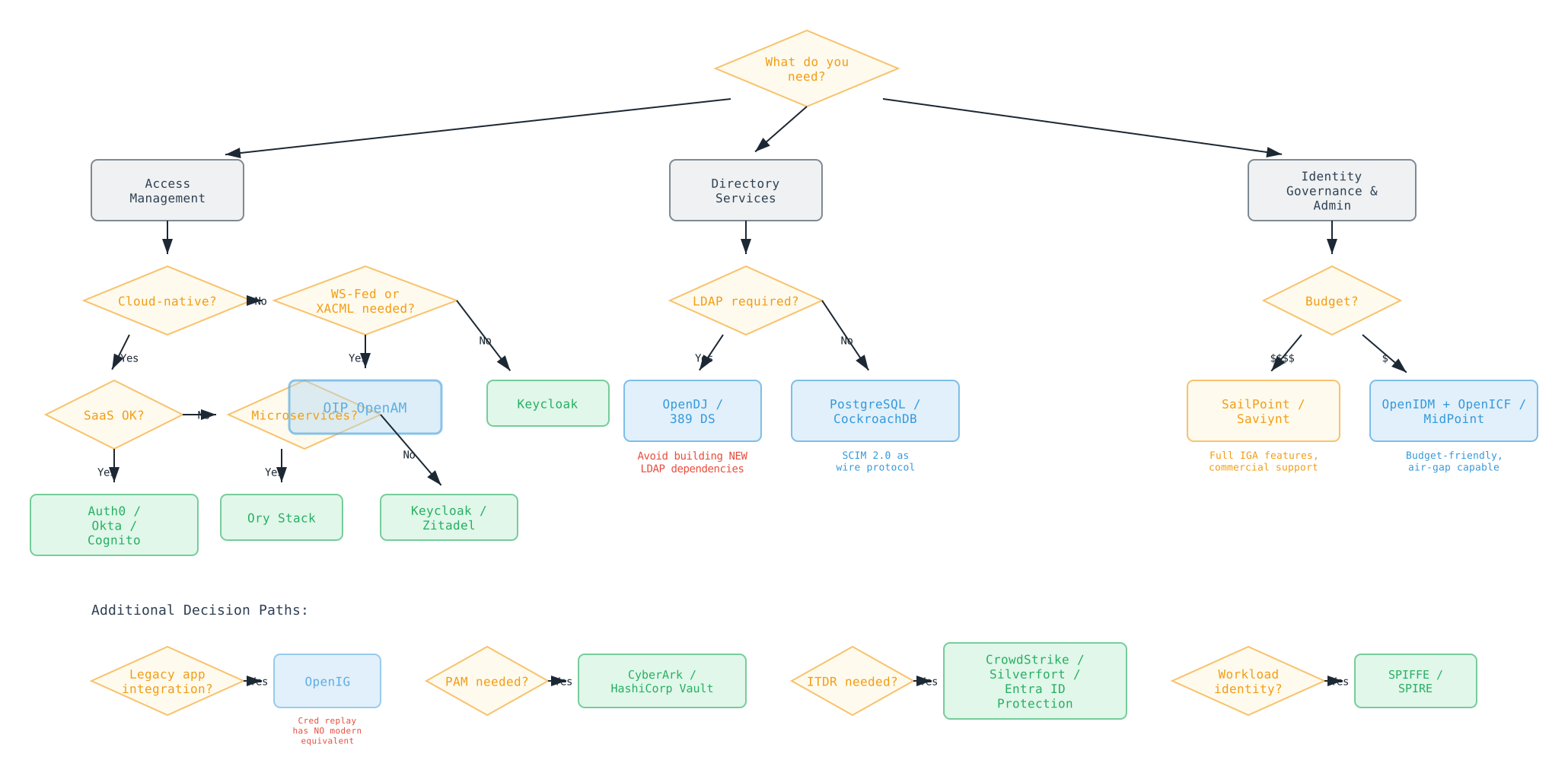
When to Stay vs. When to Migrate
Not every OpenAM deployment needs to move. The decision depends on your current fork, your protocol requirements, and your team’s operational capacity.
Stay on OIP OpenAM or Wren:AM if:
- You need SAML 2.0 IdP/SP + OAuth 2.0 + OIDC in a single WAR deployment
- Your team has existing Java/OpenAM expertise
- You have 20+ SAML partner integrations (migration coordination cost is high)
- You require XACML 3.0 policy evaluation with combining algorithms
- You operate WS-Federation or WS-Trust endpoints for legacy Windows clients
Migrate immediately if:
- You are running ForgeRock CE 11.0.3 — it has four unpatched critical RCE vulnerabilities (CVE-2021-35464 CVSS 9.8, CVE-2022-1471, CVE-2022-42889, CVE-2024-38999). Any internet-facing deployment is compromisable. Metasploit modules exist for the primary exploit.
- You need cloud-native deployment (container-native, horizontal auto-scaling, GitOps-managed)
- Your primary use case is developer-facing OAuth 2.0/OIDC with no SAML requirements
- You need managed SaaS with SLA guarantees and no operational overhead
Migration Paths by Target Platform
These estimates assume a mid-complexity deployment: 10–20 SAML partners, 5–10 custom authentication chains, 3–5 custom AMLoginModule implementations, XACML policies, and an OAuth 2.0/OIDC provider serving 20+ relying parties.
Migration to Keycloak — 3–6 months (Medium effort)
Keycloak is the closest architectural analog to OpenAM. It is the recommended target for most OpenAM migrations.
What maps cleanly:
- OpenAM realms → Keycloak realms (sub-realm hierarchy may need flattening to a flat structure)
- SAML 2.0 metadata → Keycloak Identity Provider and Client configurations (import directly; attribute mapping must be recreated manually)
- OAuth 2.0/OIDC clients → re-register each client with matching
client_id,redirect_uri, and scope; token format differences (opaque vs JWT, claim naming conventions) require client-side adjustments - User data → LDIF export from OpenDJ, SCIM/REST import into Keycloak’s database; verify password hash algorithm compatibility before migration
What requires redesign:
- Authentication chains (JAAS
REQUIRED/SUFFICIENT/OPTIONAL/REQUISITEcontrol flags) → Keycloak authentication flows with execution requirements (REQUIRED/ALTERNATIVE/CONDITIONAL/DISABLED). Complex chains withREQUISITEshort-circuiting need careful rethinking. - Custom
AMLoginModuleimplementations → Keycloak SPIAuthenticatorimplementations. The SPI contract differs but the concept is similar. Budget 2–4 weeks per complex module. - XACML policies → no Keycloak equivalent. Options: Keycloak’s UMA-based authorization services (less expressive), integrate OPA or Cedar externally, or port to application-level RBAC.
Key risk: XACML organizations must decide on an authorization architecture before starting — this is the longest lead-time item and frequently underestimated.
| Dimension | Effort |
|---|---|
| Realm/policy migration | Low — mostly configuration |
| Auth chain migration | Medium — flow redesign required |
| SAML partner migration | Medium — metadata import + manual attribute mapping |
| OAuth2/OIDC client migration | Low — client re-registration |
| XACML policy migration | High — no native equivalent |
| User data migration | Low — LDIF export → SCIM import |
| Custom module rewrite | Medium-High — 2–4 weeks per module |
Migration to Auth0 / Okta — 4–8 months (High effort)
The shift from self-hosted to SaaS introduces architectural constraints beyond code migration. Per-MAU pricing must be validated against actual user volumes before committing — organizations with millions of users may find Auth0 cost-prohibitive at scale.
What migrates reasonably:
- Social login: Auth0’s 70+ pre-built social connections replace OpenAM’s
openam-auth-oauth2module with less custom code - SAML partners → Auth0 Enterprise Connections (SAML) or OIDC connections; each partner requires coordinated metadata exchange
- Okta’s lifecycle management and provisioning features can replace some OpenIDM functionality
What is painful:
- User export from OpenDJ (LDIF) must be transformed to Auth0’s bulk import JSON format. Password hashes can be imported if the algorithm is supported (bcrypt, PBKDF2), but OpenAM-era hash schemes (SHA-256 with non-standard salt format) may require forced password resets on first login — coordinate with users in advance.
- Authentication chains → Auth0 Actions (Node.js). This is a fundamentally different programming model from Java JAAS. RADIUS, SecurID, and custom risk-scoring modules have no direct equivalent and require custom Action code.
- XACML policies cannot be migrated to Auth0. Authorization must move to Auth0’s RBAC, custom claims in tokens via Actions, or an external policy engine.
Key risk: Vendor lock-in is complete. There is no self-hosted Auth0 option and no migration path out once user identity is in Auth0/Okta.
Migration to Ory Stack — 6–12 months (Highest effort)
Ory demands the most effort due to a fundamentally different paradigm. OpenAM is a monolithic, UI-inclusive, Java-based platform; Ory is a decomposed, headless, Go-based microservices suite. Every login and registration screen must be built from scratch.
Critical blocker: SAML. Ory Hydra does not support SAML 2.0. Organizations with SAML requirements must add a SAML bridge (Satosa, Shibboleth) in front of Hydra, adding operational complexity and a dependency on a separate project.
What works well in Ory:
- OAuth 2.0/OIDC client migration to Hydra is clean — Hydra is a certified OIDC provider with standard client registration
- Cloud-native deployment: Ory is designed for Kubernetes, horizontal scaling, and GitOps workflows
- Fine-grained authorization via Ory Keto (Zanzibar-style relationship tuples) for teams adopting ReBAC
What requires complete rearchitecting:
- No realm concept — multi-tenancy requires separate Ory deployments or Ory Network projects
- Authentication chains → Ory Kratos self-service flows with webhooks and JSONNET-based data mapping. Every UI screen must be built.
- XACML policies → Ory Keto’s ReBAC relationship model. This is a different authorization paradigm entirely; policies with complex environment conditions (IP range, time window) have no direct Keto equivalent.
- User data → JSON Schema definition for each identity type, transformation from LDAP attributes to Kratos traits
Key risk: Ory requires deep Go/Kubernetes expertise that most OpenAM teams do not have. Budget for significant hiring or consulting.
The Module Assessment — Most Underestimated Task
OpenAM’s 34+ authentication modules have no single-platform equivalent. Before choosing a target platform, inventory every authentication module in use:
| Module Category | Common Examples | Typical Migration Path |
|---|---|---|
| Standard protocols | LDAP, Kerberos, X.509, RADIUS | Usually supported natively on target |
| Social / OAuth2 | Google, Facebook, Microsoft | Pre-built connections on most platforms |
| MFA | OATH TOTP, HOTP, Push | Native MFA on most platforms |
| Hardware tokens | SecurID (RSA), YubiKey | Vendor SDK integration required |
| Adaptive risk | Device fingerprint, IP reputation | Custom development on all targets |
| Legacy enterprise | MSISDN, Windows Desktop SSO | Keycloak has equivalents; Ory/Auth0 do not |
| Security Token Service | WS-Trust, SOAP federation | No modern platform supports this natively |
Modules with no target equivalent — RADIUS authentication, adaptive risk scoring, Security Token Service — require custom development or architectural workarounds. This per-module assessment is the most time-consuming component of migration planning.
Migration Effort Summary
| Keycloak | Auth0 / Okta | Ory Stack | |
|---|---|---|---|
| Estimated timeline | 3–6 months | 4–8 months | 6–12 months |
| Architecture shift | Low | High (self-hosted → SaaS) | Highest (monolith → microservices) |
| Auth chain migration | Medium (flow redesign) | High (Node.js Actions rewrite) | Highest (Kratos flows + custom UI) |
| SAML partner migration | Metadata import + manual attr mapping | Enterprise Connection recreation | Requires SAML bridge |
| OAuth2/OIDC client migration | Client re-registration | Client re-registration | Hydra registration (clean) |
| XACML policy migration | No equivalent (UMA or external OPA) | No equivalent (RBAC + Actions) | No equivalent (Keto ReBAC) |
| User data migration | LDIF → SCIM import | LDIF → JSON bulk import | LDIF → Kratos identity schema |
| Operational model | Self-hosted or RHSSO managed | SaaS (no self-hosted option) | Self-hosted Kubernetes |
| SAML 2.0 IdP support | Full | Full | Requires bridge (Satosa) |
| Vendor lock-in risk | Low | High | Low |
Greenfield Architecture Recommendations
For teams starting fresh without an OpenAM deployment to migrate:
Use Keycloak if you need enterprise IAM breadth (SAML, OIDC, LDAP federation, admin UI) with no operational budget for microservices complexity. Red Hat SSO provides commercial support.
Use Ory if you are building a cloud-native, developer-first platform and need precise control over each IAM function. Accept the UI build cost upfront.
Use Auth0 if developer experience and time-to-market matter more than cost or lock-in. Best for B2C or startup contexts.
Use Zitadel if you want a modern, Go-based, single-binary alternative with built-in audit logging and event sourcing — a strong middle ground between Keycloak’s breadth and Ory’s composability.
Use Cognito if you are already all-in on AWS and do not need to act as a SAML IdP to external partners. Cognito cannot produce SAML assertions — if you need that, look elsewhere.
Further Reading
- Platform Comparison Matrices — side-by-side feature, protocol, and licensing tables for 8 platforms
- OpenAM Deep Dive — full architecture analysis, CVE history, and fork comparison
- CVE History & Patch Matrix — why ForgeRock CE 11.0.3 must be replaced immediately